Showing posts with label concept cars. Show all posts
This was supposed to be the future! That’s what I heard. I was always told that in the future, we’d have flying cars. I’d say what happened to that, but I know what happened to that: John Mahieddine happened to that. The “Honda Fuzo” is a Vertical Take-Off and Landing concept. The Fuzo is a futuristic fantasy with four high-powered turbines for high-speed horizontal flight and Iron-Man-like handling. Cruzin in at 350 mph, two joystick control for speed, trust, and steering. Vertical spaceways for ultra-infinite possibilities.
The joysticks. Here’s how they work. There’s two joysticks, one on either side of the driver’s seat on the armrests. The left joystick “allows the car to spin on its axis,” and the right one “manages tilt and direction.”
At the floor are the normal pedals controlling power and brakes.
For safety, two things in particular:
1. Fly-by-Wire system that relies on GPS to keep cars from hitting one another.
2. Airbags that open inside AND outside of the vehicle to protect the driver, the car, and anyone in the path of the car should it get in an air-collision. (Speed Racer anyone?)
Of course, if you’re into the whole landlubber thing, you can drive on the ground with the retractable wheels (the turbines convert into these.) The vehicle is constructed of materials such as carbon fibre, Kevlar, and carbon nano-tubes. The bubble canopy allows for two passengers plus the driver, “in a very hightech comfort.”
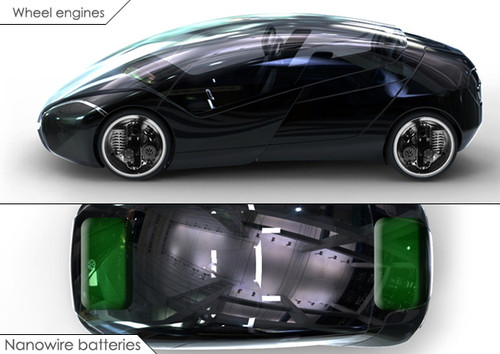
The following car aims to do the following things, all at once: provide a new luxury experience and a new way of driving. Be a family car OR a personal car at any given time. Be a smart solution for the everyday tasks of the owner. Be a space for relaxation – a part of people’s living space. This is the “Volkswagen Inside.” A new luxury concept for Volkswagen, by designer Mate Bartha. A transformable luxury electric car, customizable for 4 person, 2 person, or 1 person use in seconds.
The top of the car is a large glass surface, sort of like an extension of what we know now as the sunroof. Relaxing is what is it. Smooth, dynamic lines fill the Inside, four electric wheel engines roll it along. These electric wheel engines are based on Michelins Active Wheel System, using Nanowire Lithium-Ion batteries.
Instead of just a steering wheel, all the controls to the car are attached to the driver seat, working on a drive by wire system. The car can transform from a normal, everyday 4 seat car to a 1 seater, with the driver sitting in the center of the vehicle. Comfortable and simplified.
After creating some of the best computers, phones, tablets and music players, designers are now thinking the about the future of Apple. While some come up with concept gadgets the company can produce in the future, auto designer Liviu Tudoran has come up with a concept car for Apple. Christened the iMove, the zero-emission vehicle will be propelled by electric motors and as expected, it will feature some of the best gadgetry that we’ve ever seen in a car.
The main idea is to create an Apple branded car that will break the general idea of conventional vehicle by the year 2020. Keeping in mind the main characteristics and design language of the brand, the vehicle is inspired from Apple products and the lifestyle of those who use them. The small city car is powered by electricity and will be able to seat three passengers in a variety of configurations.
The interior space shines with a full touchscreen display that covers the entire dashboard and includes a variety of gadgets to play with. The top of the iMove is inspired by Apple’s Macintosh mouse shape and can also open while on the move to give a cabriolet feeling. The exterior surface is covered with a photochromic material that allows the user to change the vehicle’s appearance using available presets.
he Bentley Incense GT is the brainchild of auto designer Hyunjoon Park and has been inspired by the thick plume of smoke emanating from aromatic sticks. The vehicle, which has been designed for the year 2030, aims to change the brand image of Bentley with a zero-emission electric engine.
The Incense GT’s shape reflects its aerodynamic form, which enhances the vehicle’s efficiency. The use of an electric engine has also allowed the designer to abandon the conventional large grille. Other changes include round headlights with a glass cover. The designer hasn’t estimated the performance specifications but the vehicle’s aerodynamic form should allow for some decent numbers.
Yet another entrant to the LA Auto Show design challenge is the Volvo Air Motion Canyon Carver that is powered by air turbines harnessing power of wind and converting it to electric energy, and all this is done floating 1,000 feet high in the air. The vehicle weights less than a formula-1 racing car (made out of carbon fiber material) and to achieve this thousands of fewer components are used the credit for which goes to a powerful compressed air motor that eliminates the need for a heavy internal combustion engine. This motor cools down under intense driving load thereby shedding-off another important component that is a cooling system.
 To compress the air needed for the air tank, Air Replenishment sites are used that too are powered by air turbines. Talking about the looks Volvo Air Motion has a beautifully carved Scandinavian body from ultra light carbon fiber which looks more like a clam shell.
Modern roller-coaster rides give you the trill of a lifetime making you experience G-forces a fighter jet pilot would experience. Well, Honda Air coastal cruiser concept based on roller-coaster and skydiving wing-suits powered by compressed air and pneumatic regulator system pines for the same thrill quotient for its riders. Not only that, Air has turbo vacuums and external air-flow to regenerate tank pressure for extra thrust for close to 100 miles. To minimize weight to just under 800 lbs overall mass a hub-less wheel drive system, glass reinforced seating panels, urethane tire composition and skeletal sub-frame components are used.
Overall design and look of Honda Air paves way for futuristic cruiser cars that have the perfect combo of style, ride elation and most importantly zero-emission properties combined with ample power under the hood to set you heart beat racing
At the Los Angeles Auto show, Cadillac launched the Cadillac Aera (Aero + Era) that takes the brand’s philosophy of art and science to a new horizon. The specimen of Cadillac’s elegant design as well as ultra-light weight approach, Aera is a 2+2 touring coupe that weighs 1000 pounds and has a spectacular range of 1000 miles before one need to refuel tank. All these features are achieved without compromising with size, capacity and safety whatsoever.
Cadillac Aera provides best possible efficiency with minimum parts and its highly advanced structure utilizes a 3D lattice, mono-formed frame. Its structure is formed from the unique, alloy-utilizing, semi-solid freeform manufacturing that plays pivotal role in making a naturally strong, extremely lightweight frame. All major body parts, including interior components, are essentially grown into a single part lattice structure.
Alpha Romeo Flying Star project is the brain child of an Italian designer Claudio Proietto as a tribute to the grand 100 years of this legendary brand name. Taking a cue from the simple logic that form should follow function the front is minimal, clean from any air intake for the propulsion is electric, including facilitating smoother aerodynamics. While talking the alloy wheels, well they are inspired from jet engine design and Formula-1 air flow system that also cools off those brakes at high loads. Based on the chassis of the electric Caterham Seven Flying Star is designed more like a city car with vital statistics 3500 x 1686 x 1124 mm having a frame longer than 100 mm.
Another feature is the door to assisted opening, which includes much of the middle section of bodywork and windscreen made from polycarbonate. Essential interior are dominated by big screen satellite navigation, instrumentation minimal and no ventilation system.
As we all know KIA is more into making family cars, but if the brand ever makes its mind to build a Super sport, it would somewhat look like this. The brainchild of Mohammad R. Shojaie who has considerable liking for the super sport cars, this vehicle has been designed on the basis of the current design language of KIA. Dubbed the KIA Proport, which is the amalgamation of Pro plus Sport without the “S” character which means the fan of sport cars, the vehicle isn’t about designing a new style but KIA in a super-sport cloth. The vehicle has some of the famous elements of the KIA design and it seems an imagination worth commercialization.

Fuel economy, nil emissions, use of green materials, and state-of-the-art design: you just name any of these features, and you will find them all in the Toyota NORI concept car. Recently showcased at the LA Auto Show’s 2010 Design Challenge, the concept car contains several solar cells within its PODULAR form to capture and generate supplemental solar energy for the 4-wheel motor.
Contrary to current generation automobiles, the NORI concept features a Podular form that plaits the body and chassis into a single entity, and helps in reducing the overall body weight. The next-gen car, conceived by Craig Kember, Erwin Lui, and Kevin Hunter, makes profuse use of bioplastics technology for strength that uses “nori” (the Japanese word for seaweed) and a carbon fiber weave.
The Beast:
Bentley SenseS is a futuristic car concept that aims to integrate the driver and his vehicle as one with the help of genetic engineering, biotechnology and artificial intelligence. The concept car is unique and special and is custom crafted to match the needs of each individual user. The car grows and learns along with its driver and becomes a machine that recognizes the needs, emotion and feelings of its driver without any external assistance.
The Machine:
Designed by Arturo Peralta, this concept Bentley of the future roads portrays a flowing design and a wonderful aerodynamic body that reduces the wastage of energy. The SenseS attempts to make a connection with its driver and in course of time recognize him and understand all his feelings and emotions. Rather than being a car, it acts more like your loyal steed and becomes a part of your daily drive.


The Thrill:
While concepts such as the SenseS have surfaced in the past couple of months, the concepts seem too unreal to be true for now. They sound fascinating and lovely but would take many more decades to take shape, let alone hit the roads. But even without its concept of integrating the driver and the machine, SenseS still looks like a wonderful little concept car in the making.
Powered by Blogger.

Popular Posts

Blog Archive